
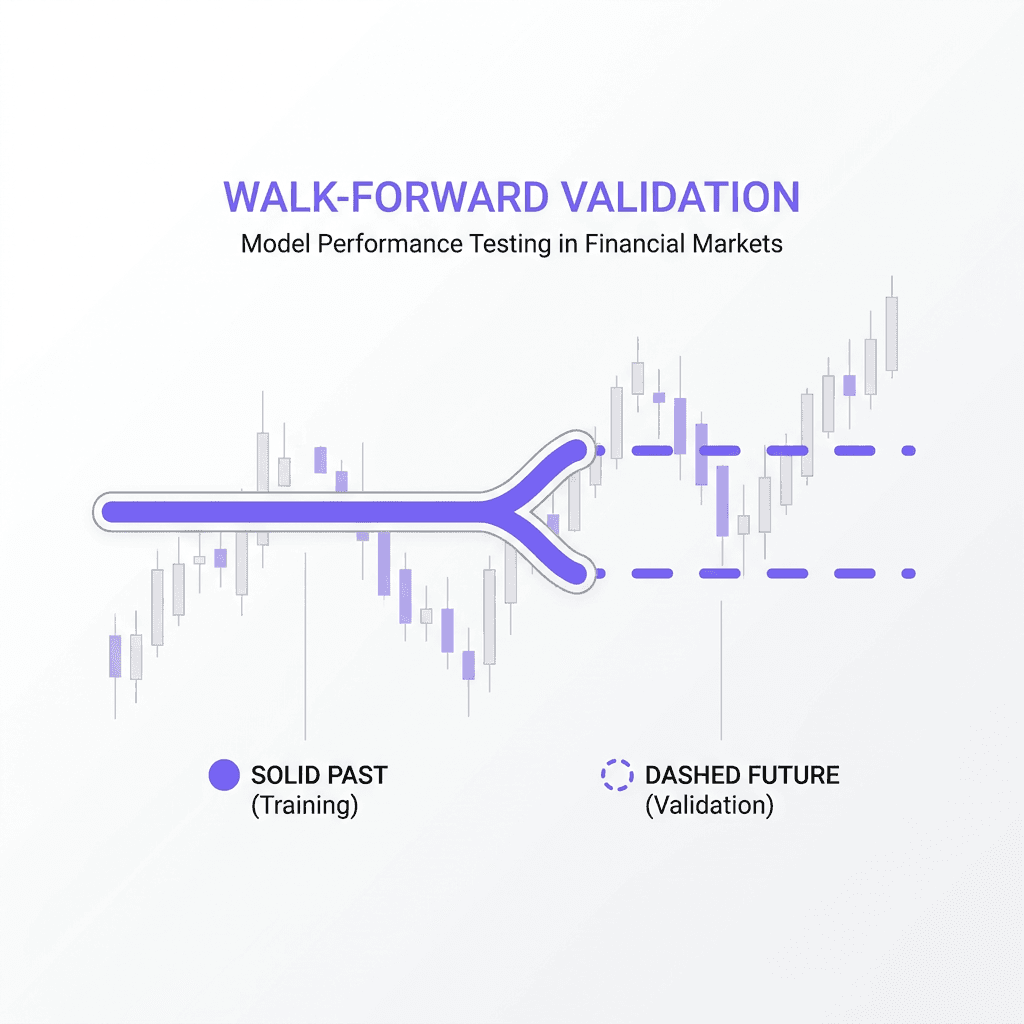
Every strategy that has ever existed looks profitable on a backtest. That's because the same data you use to design the strategy is the data you test it on, and you naturally tune until it looks good. The technical name for this is overfitting; the colloquial name is curve-fitting; the polite name is 'wishful thinking'.
Walk-forward validation is the cheapest cure. The intuition is so simple it's almost embarrassing: train on the past, test on what happens next, then slide forward and repeat.
The train-test loop
Imagine you have five years of EURUSD bars. Pick a window of 8 months — that's your training set. Tune your strategy on it. Whatever parameters you'd pick (RSI period, SL multiplier, lookback), pick them now using only the training window.
Then look at the next 2 months — your test set. Run the strategy with the parameters you froze. The performance you see on those 2 months is honest, because you didn't peek at them while choosing parameters. That's it. Now slide both windows forward by 2 months and do it again.
What this catches that backtests miss
- Strategies whose 'edge' was actually one fluke trade in 2020. The trade is in the training window for one slide, the test window for the next — and the test number drops 90%. Caught.
- Parameters that work in trending years but die in chop. The slide that lands in 2018's grinding range exposes them. Caught.
- Optimizers that overfit. If you tuned 14 hyperparameters to nail the in-sample, the out-of-sample test will be a slaughter. Caught.
Why it's still not perfect
Walk-forward gives you honest numbers, not optimistic ones — but it doesn't give you 'live' numbers. The 2 months you test on are still historical bars; slippage, partial fills, and broker quirks are absent. Reality is always worse than walk-forward, just much less worse than vanilla backtest.
We add another layer on top: every strategy that passes walk-forward then runs in paper for 30+ days before it shows up in the marketplace as 'live'. If the paper performance breaks badly from the walk-forward expectation, the strategy is pulled. The user never sees it, the marketplace stays honest.
What to look for as a buyer
- A walk-forward validated badge that actually means something. Ask how many slides, how long each, in-sample vs out-of-sample ratio. Vague answers = no validation.
- The OOS profit factor over multiple slides. Single-slide >2.0 is meaningless; six slides averaging >1.3 is real.
- A live track record that started after the validation. If 'walk-forward validated' was applied to a strategy already running, the test set is contaminated.
See the strategies we’ve put through this
Walk-forward validated, paper-tracked, live in the marketplace.