
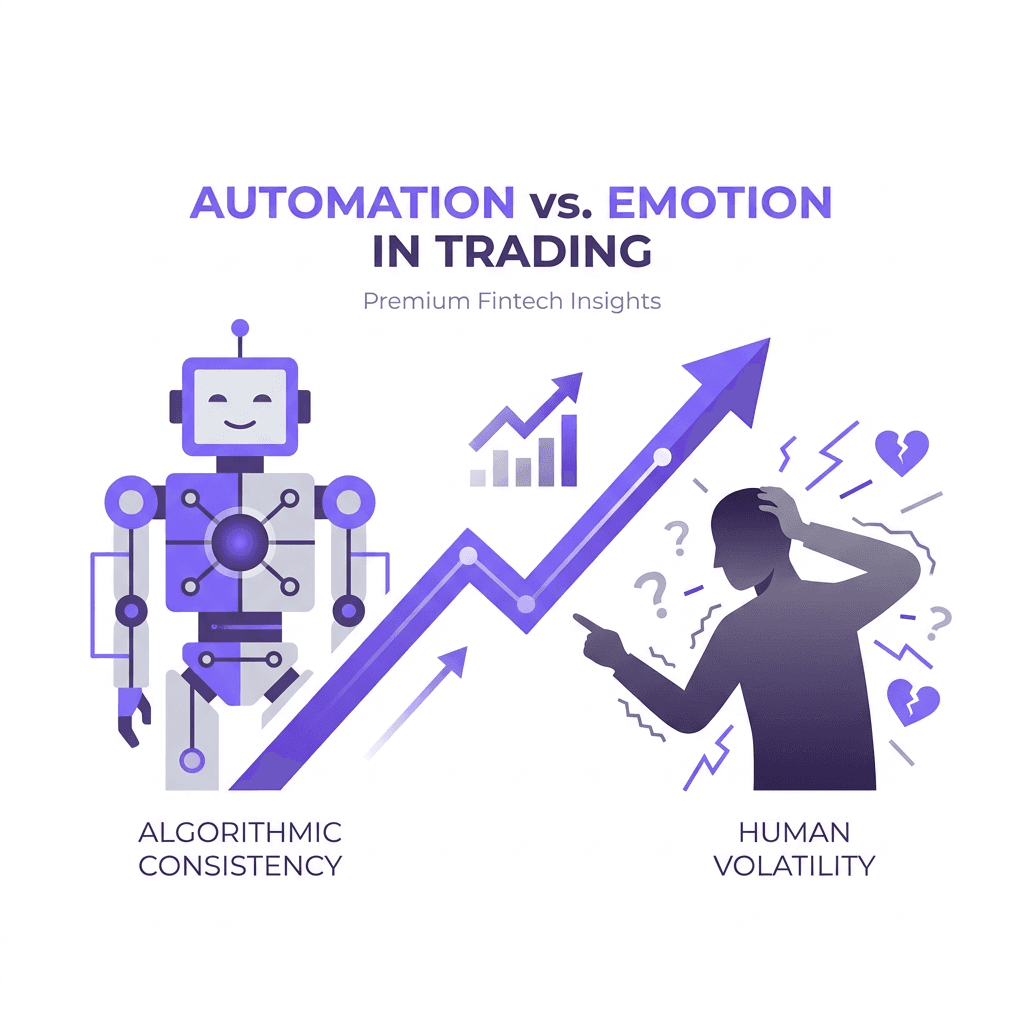
Most retail traders lose money. Not because their entries are wrong — most entries are roughly fine — but because the meta-game around the entries (sizing, holding, sticking to the plan when it stings) destroys edge faster than any signal generates it. Automation is the cheapest, most boring fix to that meta-game.
What automation actually does
Pop the hood on a trading bot and you find three things: a signal generator, a risk envelope, and an executor. None of them are magic. The signal generator computes the same indicators you'd put on TradingView, with the same parameters you'd choose. The risk envelope sizes positions based on account equity and a fixed percentage. The executor places the order at the broker.
What changes is who's holding the steering wheel when the next minute closes — a human who just read a thread on X and is starting to second-guess, or a process that has no opinion about the thread.
The edge that shows up when you remove the human
- Position sizing stays at 1% (or whatever you picked) on trade #847, exactly like it did on trade #1. Humans creep up after wins and shrink after losses — exactly when they shouldn't.
- Stops actually fire. The number of times a discretionary trader has 'just one more candle' a stop into a 4× drawdown would surprise you.
- Setups that pay 1.4R don't get vetoed because the chart 'looks weird'. Most setups look weird, that's the point.
- The trader sleeps. Markets that move at 02:14 UTC get traded by something other than insomnia.
Where a human still wins
There are two narrow windows where discretion has an edge. Both come from the same root: pattern recognition that hasn't been formalised yet.
- Regime breaks. When the macro picture shifts hard — a central bank surprise, a war headline, a structural break in correlations — strategies trained on the previous regime keep firing the previous regime's signal. A human can pull the plug while the model retrains. (Or: build a regime detector. We do.)
- Idiosyncratic events on a single instrument. Earnings, M&A, exchange halts. Your bot doesn't know META just guided down. You do. Pause that asset, let the others run.
Both fixes are operational, not strategic. You don't trade discretionary — you turn the bot off for 48 hours, then turn it back on. Five minutes of work, weeks of damage avoided.
The honest tradeoff
Automation removes upside variance too. The trader who sees a vertical-bar setup and triples their position takes home a story; the bot takes home 1R. If you genuinely believe you're in the top 1% of pattern readers, automation will feel like a tax. For everyone else, including most of us most of the time, it's the cheapest discipline insurance you can buy.
See the strategies we’ve put through this
Walk-forward validated, paper-tracked, live in the marketplace.